Hello everyone! My post for this week will be focusing on one of my favorite illustrator/manga artists’, Hajime Isayama. His work inspires me as well as many other people around the world. Isayama’s art style is very expressive and unique as well as his story telling and the way he conveys emotion through the characters he creates for his stories.
Hajime Isayama was born August 29, 1986 in Oyama, Oita, Japan. Once he graduated high school, he pursued his career of becoming a manga artist by enrolling in a cartoon design program at Kyushu Designer Gakyin. After he graduated, he went on to create manga of his own. One of his most popular and most well known mangas is

Back in 2009 and it’s still on going with only 5% of the story to go. The series, 4 years after it’s release, got an anime adaption that took the world by storm in 2013. The anime currently has 3 seasons with it’s 4th finale season in the works. The series has achieved many awards over the years like the Fine Work Award (2006) for the early serialization of
Attack On Titan: Before The Fall
, the Kodansha Manga Award (2011), the 17th Michelazzi Award (2014), as well as the Harvey Award (2014). Hajime Isayama has also made other manga like
Isayama’s art style is very raw and emotional. The expressive lines really help to convey the emotion to the reader. His line work is also very bold and detailed, that’s what is very captivating about his style, he’s not afraid to be bold and go out of the box. The cross hatching technique he uses for a lot of the examples I have shown above, gives the characters depth and I like this shading technique because it doesn’t look smudged instead it looks clean and crisp. He only uses a little bit of greyscale tones under the cross hatching to give it some form of color and that’s what I find to be unique about his work, it’s very simple and minimal. It also brings emphasis to the characters’ features, for example, the face. Isayama is very good at bringing really raw emotion to the face with cross hatching and many different types of lines. I find what he does extremely well is making his characters look realistic even though it’s animated.
My style of drawing is kindled by Isayama’s work and style and he is one of the biggest inspirations for me because even though some people told him that he wasn’t very good in the beginning, he defied that and he improved so much. As an artist you can only improve.. The series has become a phenomenal commercial success. As of July 2015, the manga has 52.5 million copies in circulation. Its popularity was spurred on with the release of the anime adaptation of the same name.
Attack On Titan Creator Writes Letter To Fans As Series Returns With Colour Art Book And New One Shot
Isayama would doodle “ugly stuff” as a child. By the time he reached high school, that was almost all he would draw. It was during high school that his ambition to make a living from drawing manga grew. And so He began submitting his artwork to contests. After high school, he enrolled in a manga design course at Kyushu Designer Gakuin.
To the Magazine Grand Prix (MGP). Which won him his first ever prize, the “Fine Work” award. At age twenty, Isayama moved to Tokyo to pursue a career in manga. He left the idea behind him, with no intention of revisiting it.

He found work at the Weekly Shonen Magazine and entered his mangas to their Freshman Manga Award. He won a Special Encouragement Award, and the following year his manga,
Attack On Titan Season 3 Part 1 Manga Box Set' Von 'hajime Isayama'
Isayama spent half a year expanding the world and its characters. His editor also insisted that he have an ending in mind. In 2009, Isayama’s first serial work,
, began its run in the monthly Bessatsu Shonen Magazine. The series was a triumph, winning the Shonen category of the 35th Kodansha Manga Award in 2011, and getting nominated for the 4th annual Manga Taisho award and the 16th annual Tezuka Osamu Cultural Prize.
Every one of Shingeki no Kyojin’s English volumes have made The New York Times Manga Best Sellers list. Volume 1 is almost a permanent fixture on the list and has taken the number one slot five times. The huge success of the manga spawned spin-off manga series, two light novel series, a television anime adaptation, several visual novels, a video game, a two-part live-action film, and even a Shingeki no Kyojin themed shop.
Attack On Titan Manga Ends On April 9 After 11 Years
To find out more about Hajime Isayama, you can read this excellent interview with Brutus magazine, and watch this short BBC interview. You can also follow his work on his blog.Hajime Isayama is a Japanese manga artist, most famous for his signature series 'Attack on Titan' (2009-2021). The battle between mankind and a threat of cannibalistic giants quickly became a cult hit. A cross between a war comic, horror story and metaphor for humanity's struggles, 'Attack on Titan' has been praised by critics and general audiences alike. The series also found success in translation, eventually becoming one of the best-selling Japanese comic series in the world. 'Attack on Titan' has been adapted into light novels, video games, a musical, a 2015 live-action film and a succesful anime TV series (2013-2023).
Hajime Isayama (諫山 創) was born in 1986 in Oyama Oita, in the south west of Japan. He enjoyed drawing from a young age, but his interest for manga only grew when his elementary school teacher gave his class an assignment about recycling. As Isayama rummaged through old thrown-away stuff, he discovered several crumbled magazines and books. Some were manga, which he read and made him excited about creating his own stories. Among his main graphic influences were Hideki Arai, Morikawa George, Seo Koji, Ryouji Minagawa, Kentaro Miura, Tsutomo Nihei and Makoto Yukimura. In high school, Isayama started submitting comic stories to various drawing contests. After graduation, he took a course in manga design in the arts department at Kyushu Designer Gakuen in Fukuoka, while earning part-time income in an Internet café. In 2006, one of the school's assignments required submitting artwork to a publisher in Tokyo. Since travelling in group was cheaper than going alone, 19-year old Isayama went to the Japanese capital with some of his fellow art students. With him, Isayama already had an early draft of what would later become 'Attack on Titan', albeit in the shape of a one-shot book.

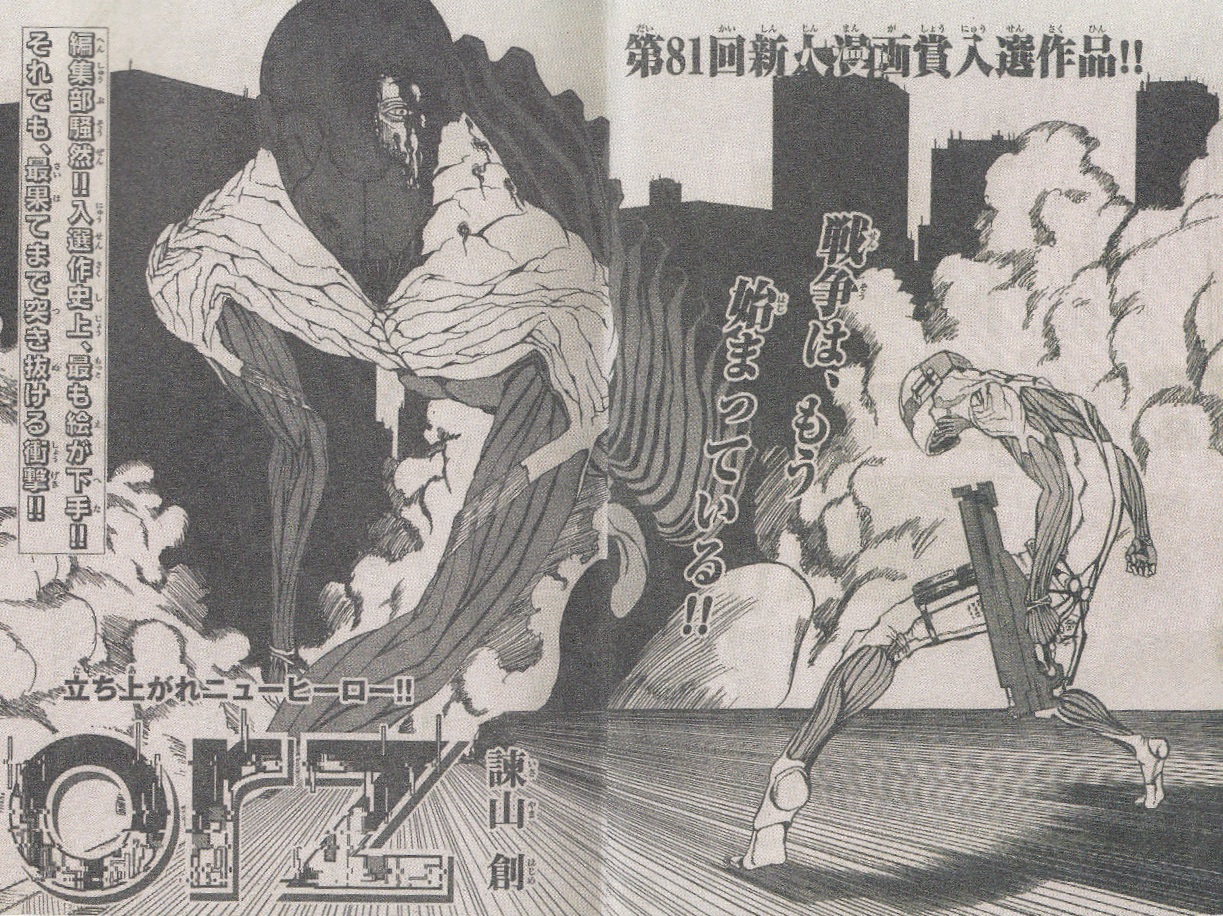
Almost all editors rejected Isayama's work, because they felt his rudimentary, sketchy style looked too rough. Isayama was aware that his graphic skills were limited, but at the same time he regarded this as a personal strength. Interviewed in the culture magazine Brutus (November 2014), Isayama stated: Just like everyone's handwriting is unique to them. I think my art is idiosyncratic to me in its ugliness: people got a kick out of it and it somehow caught on. (...) I was scared of being a run-of-the-mill tree with run-of-the-mill leaves that'll blend right into the forest. Better to have memorable art, even memorable bad art, and stand out. The only person who saw something in his comics was Shintaro Kawakubo, editor of Weekly Shonen Jump. He suggested to Isayama to try and win the magazine's Special Encouragement Award for young and aspiring artists, since the winning story would automatically be serialized in Weekly Shonen Jump's pages. Encouraged, Isayama spent the following two years crafting two totally different stories: 'Heart Break One ('ハート ブレイク ワン' 'Hāto Bureiku Wan', 2008) and 'Orz' (2008). He deliberately made them as standard as possible, with a clear, easy-to-follow lay-out, plot and artwork. When they indeed won the intended award, he gained more prestige. Veteran artist Saton Yuuki asked him to become his assistant and he agreed. Another mentor who encouraged Isayama was manga artist Shuzo Oshimi (known for 'Flowers of Evil').
Am I The Only Who Liked The Art Of Shingeki No Kyojin (manga)?
The early draft of 'Attack on Titan' ('進撃の巨人', 'Shingeki no Kyokin') that Isayama presented to several manga magazines in 2006 was still condensed as a 65-page one-shot story. By the time he had published his first two comics in Weekly Shonen Jump had almost forgotten about his first project. But his editor Kawakubo still remembered the comic and suggested seralizing this story instead. He only suggested a few changes in the artwork and plot.
Isayama was surprised, but enthusiastic about giving 'Attack on Titan' front pass. He had already concluded that his prize-winning stories were just routinous manga, made without much passion. Interviewed in Weekly Shonen issue #41 (2017), Isayama said: I understood that a standard manga doesn't automatically have strong appeal. Since then I've always kept the thought of doing whatever I want in mind when I draw. In my view, creating with a sense of freedom is the only way to capture an author's personality and charm. (...) I hope everyone can demonstrate the 'wild side' hidden within their hearts. (...) If you have any idiosyncracies that you cannot bear the general public ever discovering, I think you should actually illustrate exactly that in your works! (...) I hope you

Isayama spent half a year expanding the world and its characters. His editor also insisted that he have an ending in mind. In 2009, Isayama’s first serial work,
, began its run in the monthly Bessatsu Shonen Magazine. The series was a triumph, winning the Shonen category of the 35th Kodansha Manga Award in 2011, and getting nominated for the 4th annual Manga Taisho award and the 16th annual Tezuka Osamu Cultural Prize.
Every one of Shingeki no Kyojin’s English volumes have made The New York Times Manga Best Sellers list. Volume 1 is almost a permanent fixture on the list and has taken the number one slot five times. The huge success of the manga spawned spin-off manga series, two light novel series, a television anime adaptation, several visual novels, a video game, a two-part live-action film, and even a Shingeki no Kyojin themed shop.
Attack On Titan Manga Ends On April 9 After 11 Years
To find out more about Hajime Isayama, you can read this excellent interview with Brutus magazine, and watch this short BBC interview. You can also follow his work on his blog.Hajime Isayama is a Japanese manga artist, most famous for his signature series 'Attack on Titan' (2009-2021). The battle between mankind and a threat of cannibalistic giants quickly became a cult hit. A cross between a war comic, horror story and metaphor for humanity's struggles, 'Attack on Titan' has been praised by critics and general audiences alike. The series also found success in translation, eventually becoming one of the best-selling Japanese comic series in the world. 'Attack on Titan' has been adapted into light novels, video games, a musical, a 2015 live-action film and a succesful anime TV series (2013-2023).
Hajime Isayama (諫山 創) was born in 1986 in Oyama Oita, in the south west of Japan. He enjoyed drawing from a young age, but his interest for manga only grew when his elementary school teacher gave his class an assignment about recycling. As Isayama rummaged through old thrown-away stuff, he discovered several crumbled magazines and books. Some were manga, which he read and made him excited about creating his own stories. Among his main graphic influences were Hideki Arai, Morikawa George, Seo Koji, Ryouji Minagawa, Kentaro Miura, Tsutomo Nihei and Makoto Yukimura. In high school, Isayama started submitting comic stories to various drawing contests. After graduation, he took a course in manga design in the arts department at Kyushu Designer Gakuen in Fukuoka, while earning part-time income in an Internet café. In 2006, one of the school's assignments required submitting artwork to a publisher in Tokyo. Since travelling in group was cheaper than going alone, 19-year old Isayama went to the Japanese capital with some of his fellow art students. With him, Isayama already had an early draft of what would later become 'Attack on Titan', albeit in the shape of a one-shot book.
Almost all editors rejected Isayama's work, because they felt his rudimentary, sketchy style looked too rough. Isayama was aware that his graphic skills were limited, but at the same time he regarded this as a personal strength. Interviewed in the culture magazine Brutus (November 2014), Isayama stated: Just like everyone's handwriting is unique to them. I think my art is idiosyncratic to me in its ugliness: people got a kick out of it and it somehow caught on. (...) I was scared of being a run-of-the-mill tree with run-of-the-mill leaves that'll blend right into the forest. Better to have memorable art, even memorable bad art, and stand out. The only person who saw something in his comics was Shintaro Kawakubo, editor of Weekly Shonen Jump. He suggested to Isayama to try and win the magazine's Special Encouragement Award for young and aspiring artists, since the winning story would automatically be serialized in Weekly Shonen Jump's pages. Encouraged, Isayama spent the following two years crafting two totally different stories: 'Heart Break One ('ハート ブレイク ワン' 'Hāto Bureiku Wan', 2008) and 'Orz' (2008). He deliberately made them as standard as possible, with a clear, easy-to-follow lay-out, plot and artwork. When they indeed won the intended award, he gained more prestige. Veteran artist Saton Yuuki asked him to become his assistant and he agreed. Another mentor who encouraged Isayama was manga artist Shuzo Oshimi (known for 'Flowers of Evil').
Am I The Only Who Liked The Art Of Shingeki No Kyojin (manga)?
The early draft of 'Attack on Titan' ('進撃の巨人', 'Shingeki no Kyokin') that Isayama presented to several manga magazines in 2006 was still condensed as a 65-page one-shot story. By the time he had published his first two comics in Weekly Shonen Jump had almost forgotten about his first project. But his editor Kawakubo still remembered the comic and suggested seralizing this story instead. He only suggested a few changes in the artwork and plot.
Isayama was surprised, but enthusiastic about giving 'Attack on Titan' front pass. He had already concluded that his prize-winning stories were just routinous manga, made without much passion. Interviewed in Weekly Shonen issue #41 (2017), Isayama said: I understood that a standard manga doesn't automatically have strong appeal. Since then I've always kept the thought of doing whatever I want in mind when I draw. In my view, creating with a sense of freedom is the only way to capture an author's personality and charm. (...) I hope everyone can demonstrate the 'wild side' hidden within their hearts. (...) If you have any idiosyncracies that you cannot bear the general public ever discovering, I think you should actually illustrate exactly that in your works! (...) I hope you
0 Response to "Hajime Isayama First Manga"
Posting Komentar